

MCF: Ethiopia E-Learning

UX • RESEARCH
UX research + experience strategy for developing the first-ever Learning Management System (LMS) in Ethiopia to enable 50 higher learning institutions across the country
ROLE
UXR, experience strategy, discovery phase leadership
DELIVERABLES
UXR plan, facilitation of generative research activities, information + technical architecture, discovery workshops, UXR reports, UX documentation
Background
The Mastercard Foundation embarked on the initiative to collaborate with the Ministry of Education (MoE) to help the country build its technology to scale up digital education across 50 institutions in Ethiopia. The initiative’s goal is to ultimately expand online learning delivery and potentially reach 800,000 young people across the country.
The partnership, powered by a grant from the Mastercard Foundation, will enable 50 Ethiopian higher learning institutions to expand online learning delivery and potentially reach 800,000 young people across the country. The Mastercard Foundation already had previous experience implementing successful digital learning experiences on the continent, especially when developing The Baobab platform, a social and professional network for Mastercard Foundation alumni and young African leaders to pursue various graduate degree programs related to the educational technology field such as user experience, information technology, learning sciences and software engineering. The potential direct impact is 800,000 students and 35,000 faculty and instructors. Fast-tracked by the COVID pandemic, Ethiopia only recently passed a bill that enabled higher education institutions to teach undergraduate and postgraduate students online. Currently, only a few private and public higher education institutions provide online education after getting accredited by the Higher Education Relevance & Quality Agency (HERQ).
Overview
Our team was working alongside the Ethiopian Ministry of Education to help the universities create learning management and student information systems, as well as train faculty, staff and students. Since 2012, the Mastercard Foundation Scholars Program has been enabling exceptional young people, primarily in Africa, to access quality higher education. Mastercard Foundation Scholars come from diverse backgrounds but share a deep commitment to service, having faced significant social and economic barriers to their learning and leadership. The new partnership in Ethiopia is aligned to the Mastercard Foundation’s Young Africa Works strategy, which aims to enable 30 million young people in Africa, particularly young women, to access dignified and fulfilling work by 2030. Around 160,000 students entered Ethiopia’s public universities last year.
Challenge
One of the main challenges of the project was not only its impressive scale, but also making sure we’re carefully listening to the voices of all stakeholders and various parties involved in this ambitious initiative. Oftentimes, our team would experience difficulties when conducting user interviews due to connectivity issues and other technical interruptions. Apart from user interviews and discovery activities, another challenge was prioritizing mobile experience due to limited access to personal computers on the continent, therefore we had to make sure we mitigate any potential usability issues associated with smaller screen sizes. Considering that each university has its own infrastructure, resources, technology capacity, and preferred ways of operating and getting things done, we had to put together a feasible yet robust technical architecture to ensure optimal scalability and reliability. As far as meeting cadence goes, we made sure to find the most effective way to touch base with all stakeholders and various parties on a regular basis while respecting a significant time difference (Addis Ababa is 8 hours ahead of New York).
High-Level Strategy
Since one of our main focus areas was ensuring optimal scalability and reliability of proposed technical architecture, our team spent a lot of time building trust and asking questions to fully understand the context. In addition to meeting with representatives from the Ministry of Education, our team also met with technology experts, registrars, faculty, students, and university presidents. Our goal was not only working alongside the Ministry of Education to help Ethiopian universities create learning management and student information systems, but also train faculty, staff and students to lay down a foundation for future initiatives and needs.
To support scalability, we proposed a clustering approach, focusing on addressing the needs of five chosen universities by providing them with a proper technical and infrastructural support. Once fully equipped, these universities will be responsible for collaborating with other institutions and training faculty, staff and students on how to navigate and support implemented LMS. While there will be a uniform core technology infrastructure, each of the universities will be able to customize its platform by choosing different functions.
Discovery Phase
As a discovery and research lead, I worked on putting together a research plan that will accommodate project’s requirements, limitations, and needs. The primary goal was to analyze data on higher education in Ethiopia, audience’s overall experience with e-learning & LMS platforms, and to better understand user workflows and mental models to gather valuable insights for the project. Data points related to audience’s frustrations, pain points and needs are the key factors to inform potential design and technical considerations.
After going through stakeholder & SME workshops (kickoff, assumption making, affinity mapping, problem framing), our team had a solid grasp of the problem space and enough context to move forward, which helped us to identify gaps and key areas of exploration we wanted to focus on during discovery phase of the project:
Ethiopian Context. Background, current role, demographics, contextual limitations, observations and reflections.
Higher Education. Overall experience, blended learning (aka hybrid learning = onsite vs offsite activities), frustrations and pain points, wishlist.
Workflow. Overall process, high-priority tasks, challenges, time on task (TOT).
Troubleshooting. Technical support & ICT experience, frustrations and pain points, workarounds.
Connectivity. Power outages, network disruptions and coverage, Internet availability.
Mobile Access. Overall mobile experience, frustrations and pain points, in-browser vs native app usage.
E-learning Experience. Overall experience and workflow, frustrations and pain points, wishlist.
Accessibility Support. Overall experience and workflow, frustrations and pain points, wishlist.
Technology Advancement Level. Familiarity with technology, frustrations and pain points, workarounds.
In our research approach, we decided to focus on the following discovery activities and exploratory research methods based on our scope and available resources: stakeholder interviews, user interviews, and SME interviews. As our strategy was centered around investigating people’s motivations and needs, field studies would’ve been extremely effective to cover missing data, but, unfortunately, it wasn’t available to our research team due to multiple logistical and political limitations, therefore, in-depth user interviews had to be prioritized. Occasionally, we would replace in-depth user interviews with email correspondence due to technical interruptions or connectivity issues at the participant’s location.
Apart from generative research activities, our final research plan also incorporated technical discovery activities, including analyzing and gathering technical requirements, understanding best UX practices, potential API integrations, and accessibility compliance.
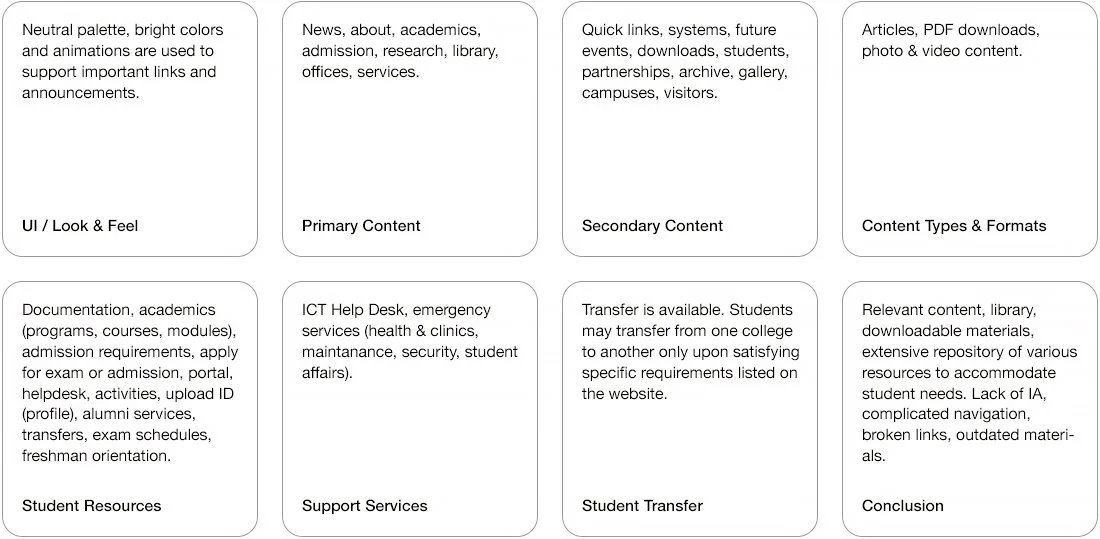
Fragment of performed comparative analysis (CA) and content audit on the existing universities and their online presence to evaluate user interface, content, resources, services, etc.
User Segmentation
When it came to user segmentation, the most feasible approach for us was leveraging the expertise of the students who had previous experience using The Baobab platform because these students come from diverse backgrounds and can potentially reflect on their online learning journey as far as technology adoption goes. With that approach in mind, three main user segments were prioritized:
Baobab students
Ethiopia-based students
Baobab ambassadors (former Baobab students who subsequently became mentors)
These three groups helped us to paint a full picture and fill the gaps in the overall context of the project because each one of them represents different types of familiarity with online learning systems. Within each segment, here’s what we primarily focused on:
Baobab students. Cultural environment and context, fears and frustrations, limitations (tech + contextual), workflow, troubleshooting, familiarity with technology, Baobab e-learning experience;
Ethiopia-based students. Cultural environment and context, fears and frustrations, limitations (tech + contextual), workflow, troubleshooting, familiarity with technology, LMS-agnostic e-learning experience;
Baobab ambassadors. Cultural environment and context, fears and frustrations, limitations (tech + contextual), workflow, troubleshooting, familiarity with technology, Baobab e-learning experience, unique perspective as an ambassador.
From each one of these groups, students with disabilities were also carefully studied to make sure our proposed solution covers their needs and aligns with accessibility requirements. Although system’s behavior and content is rather linear and supports a universal user journey for all students, it’s important to ensure proper user segmentation to better understand mental models by carefully studying accurate behaviors, environments, attitudes, and needs of real users.
Research Synthesis
After conducting dozens of user interviews and gathering sufficient information, we moved onto affinity diagramming to extract and summarize data, find patterns across participants, create insights, and organize them into a digestible format. Once similar information was clustered into themes and properly labeled, we were able to see how different data might relate to each other, and potential underlying reasons for different behaviors and needs.
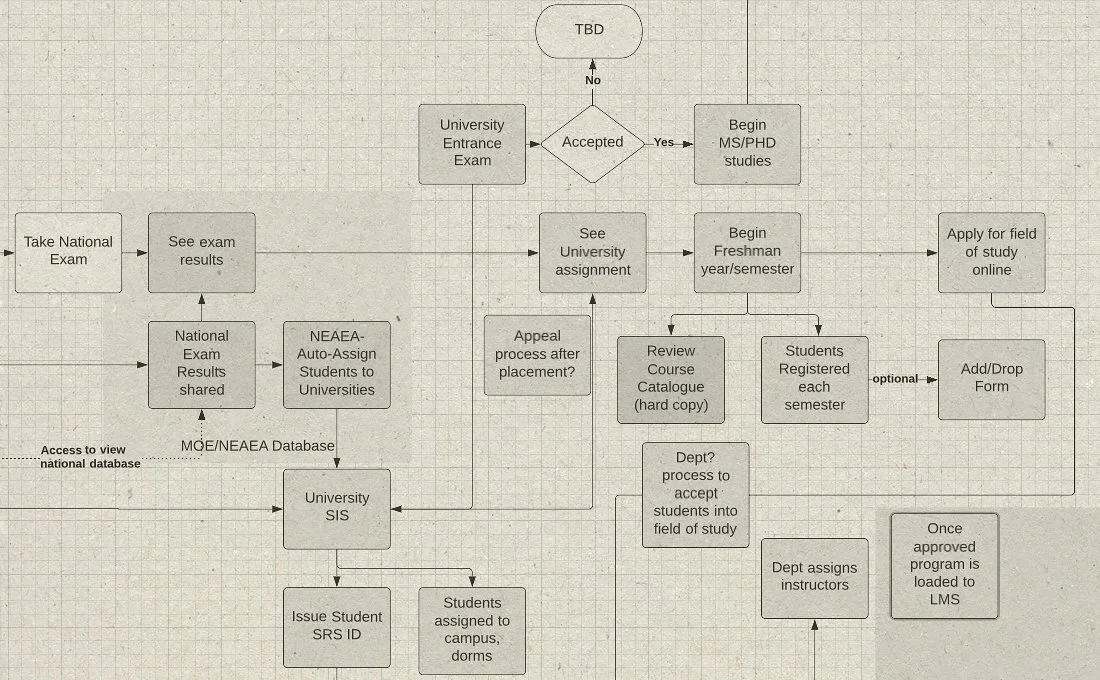
Excerpt from a user flow for one of the participating universities created in collaboration with the university representatives as a part of UX workshops and other discovery activities.
Finally, we organized insights and themes of information into visual artifacts to present to stakeholders and other parties: personas, empathy maps, and service blueprint. Final research report also incorporated extracts from other research activities such as desk research, comparative analysis of the five proposed universities, as well as multiple workshops with the representatives from each university.
Insights & Opportunities
Since I can’t share exact insights due to NDA agreement, I thought it would be appropriate to share How-Might-We (HMW) statements that emerged during data analysis and synthesis across five data clusters:
Ethiopian context. How Might We: make technology more accessible; support existing usage of communication tools; digitize manual processes; support streamlined e-learning process; accommodate students with limited access to equipment; increase credibility and provide multi-level support to all students?
Higher education. How Might We: increase the quality of course design; provide adequate training for the university personnel; accommodate technology adoption by the staff responsible for both operational and technical support; build capacity to meet existing needs; provide additional support to students to alleviate their pain points; find a feasible balance between onsite and offsite functionality to support blended learning?
AccessibilityTechnology Adoption & Tech Support. How Might We: integrate robust ICT support and provide users with corresponding functionality to accommodate their needs and requests; train the university stuff to support technology adoption to subsequently accommodate student needs; showcase additional signage and onboarding to make learning process more intuitive and user friendly; bring all students to the same level of technological advancement regardless of their background and familiarity with technology; support the needs of students with disabilities, not only with the help of technology, but also with the help of operational effort and adequate mentorship?
Mobile Access & Connectivity. How Might We: optimize loading times on mobile devices; provide enough functionality on mobile devices to support completing assessments and accessing content in use cases when mobile is the only touchpoint; optimize all content for faster access to course materials; support scenarios of power outages and prompt users to pre-download content on their mobile devices; make sure that users are aware of the value of pre-downloading content in order to keep up with their learning activities in case of technical interruptions?
LMS & E-learning. How Might We: provide the most relevant selection of courses to accommodate specific student needs; increase content findability with the help of intelligent search and personalization logic to support proper targeting; build user trust by providing relevant content and demonstrating value; educate users on the role of LMS and its potential capabilities?
Takeaways
As our team was moving through a discovery phase of the project and associated research activities, 97% of received synthesized data confirmed that Ethiopian graduate students were interested in online learning. Lack of e-learning support is especially challenging for women since they have to keep up with family responsibilities, all the while attending classes and working full time. Some students are traveling long distance (50-60 km) everyday back and forth to attend classes, which makes e-learning opportunities highly desirable.
Next to technological infrastructure, both staff and students greatly determine the success or failure of e-learning implementation at a university level. Effective e-learning can be feasibly implementable by using the adequate infrastructure and resources as well as by considering motives of students and lecturers in each university. However, e-learning in Ethiopia has not yet been fully implemented in the form of non-physical presence of lecturers and students. Some of the challenges include, but not limited to: lack of technological skills, high cost of e-learning incentives, lack of strategies, lack of computers, culture of the university teaching and learning processes, student’s fear of exposure in a new environment, etc.
Key areas of focus include, but not limited to: technological advancement, enhancing teaching and learning, meeting students’ expectations, improving students’ technological skills, distributing course materials, supporting power outages and connectivity disruptions. Additionally, the culture of online learning needs to be created: more technologically advanced environment (dedicated Internet connection and availability of computer and other electronic devices for each student), as well as financial support from government and other organizations to support designing and preparing e-learning courses. Revision of educational model at a national level is also one of the potential considerations. Therefore, full implementation of e-learning must be based on the proposed framework that combines both traditional and e-learning concepts.
Potential opportunities that are gained from e-learning adoption include, but not limited to: increased availability of academic resources; shared repository of course materials for long-term referencing and self-updating; additional communication channels for lecturers and students, improved quality of education, customizable student experience that allows for more flexibility, etc. The university needs to create e-learning guidelines, policies, strategies and plans for future implementation. Additionally, the management needs to support the use of educational technologies to improve quality of education and to adopt modern-day technology. Capacity building and digital literacy training on the diverse use of technology should be one of the primary concerns.
The infrastructure at the university level must be strong, scalable, and backed up by advanced technical skills. Finding continuous and sustainable finance from government and international organizations needs to be prioritized to support teaching and learning activities. To ensure e-learning sustainability, the Ministry of Education needs to design effective e-learning programs in all universities with the involvement in planning, development and delivery processes. In addition, developing ICT policies and strategies to address curriculum issues is necessary to support effective implementation of e-learning.
