
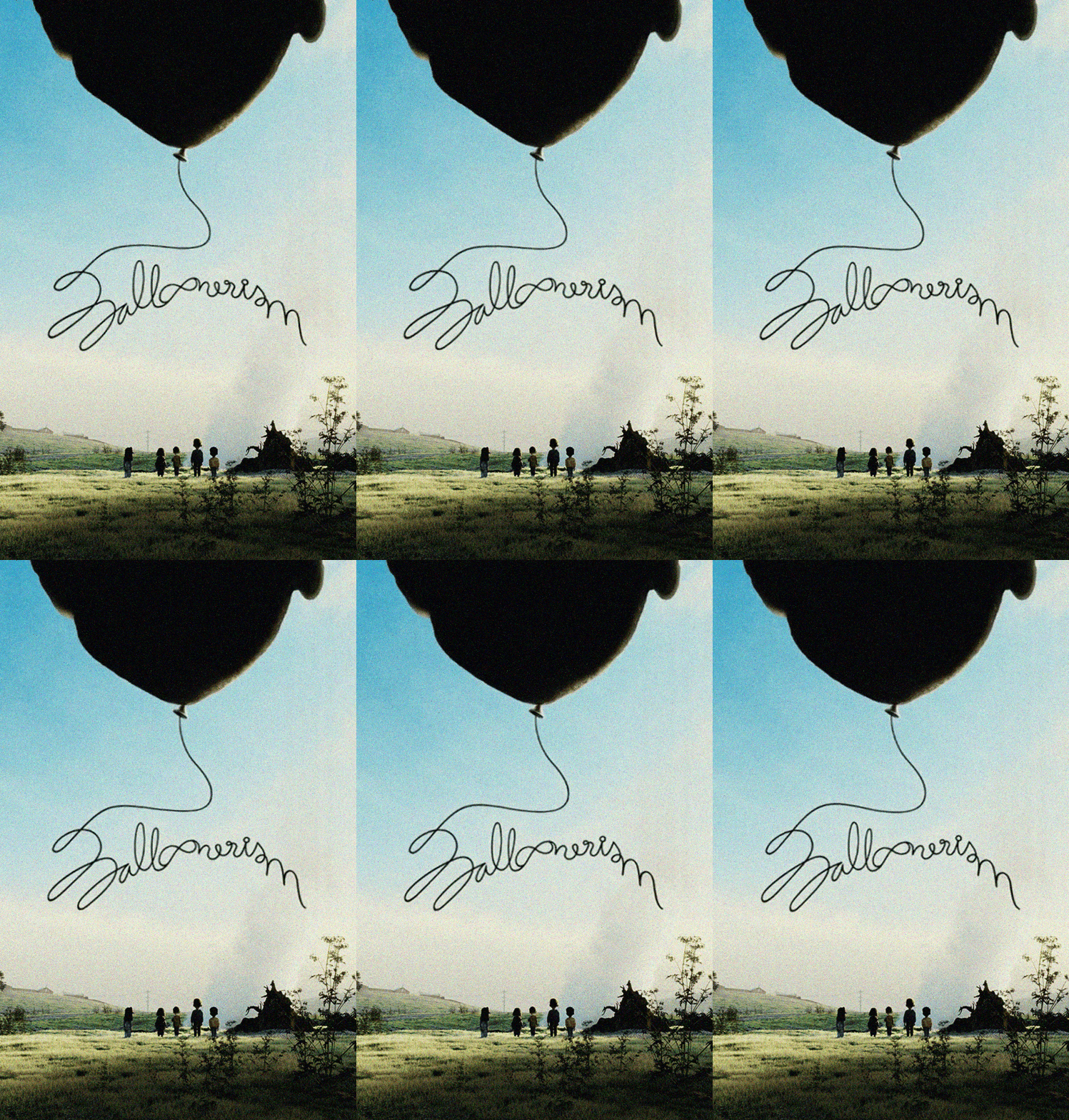
Intro
KELLY KORZUN: Hey, how are you? Hope you’re feeling better. It’s been a minute.
SAM MASON: I’m doing good, thank you. I’m better from the flu. Slept twelve hours or something, which is good.
KK: Great. First off, congrats again on Balloonerism and everything it has blossomed into. It’s such an amazing body of work, which I’m very excited to talk to you about today, especially considering that I knew about the project since its very early stages. When the film came out, I was very tempted to reach out and offer to chat, but, to be completely honest, I try not to approach the artists when they are in the process of surviving the press vortex because by presenting the project you learn a lot about it in retrospect, so I prefer to wait for the dust to settle a bit. When I first thought about reaching out to you almost a year later, I remember thinking to myself: “I hope Sam won’t think I reached out because of the scarf I left at his place two years ago.”
SM: It’s been two years already? Wow.
KK: I know. Post-pandemic concept of time is wild. It’s ok if you don’t have it. As Joni Mitchell said, “something’s lost and something’s gained in living every day”, and Joni Mitchell never lies.
SM: Oh, I’m sure I still have it. I’m gonna look for it.
KK: But I remember that around the same time you shared some very early concepts of Balloonerism with me when you were looking for the artists to collaborate with on the film. It’s been two years, but it doesn’t feel that long. To me, it feels more like reuniting with an old friend or a fellow dreamer. The creative community in NYC, and in Brooklyn specifically, is pretty tight, so all the artists whose work has a similar quality to mine, this dreamlike surrealist aesthetic, feel like family to me, people like you, Mario Hugo and Saad Moosajee. This quality might originate from different sources, but there’s a very specific language that we use…the longing for home, the nostalgia.
SM: Yes, definitely. I get what you mean. Certain naiveté.
KK: When I was doing a deep dive into Mac Miller material, I came to realize that I totally missed this entire era. Now, I’m openly a fan, but I didn’t quite realize the scale of Mac Miller when he was in the spotlight or even after he passed away and all fellow artists, fans and collaborators vocalized how much he meant to them. He meant so many things to so many people.
SM: I think it’s a generational thing. When he was making music, I wasn’t keeping up with what was happening in mainstream music at the time, and I think his music belongs to the generation below us. I only found out about him when he passed away, just like you.
KK: Yes, I think you’re right. If I had to think about an example that’s more relevant to our generation, it would be Chester Bennington and Chris Cornell. There’s always an influential figure like that for each generation.
SM: Yes, but now I see a lot of young kids who are fans of Mac Miller as well.
A friend of mine, who is a painter, who’s actually helped with some of the designs for the film, his daughter who is 17-18, she is a big fan of Malcolm. I was really humbled and touched by learning more and more about how much he meant to other people. When you’re working on a music video for an artist, I don’t think that it’s a pre-requisite to have a connection to the music. It’s always been complicated for me when I loved a band and thought about making a music video for them. First of all, most of the stuff that I liked wasn’t contemporary, so it wasn’t an option, but I think it can get in the way. I did a video for The Strokes, and I loved them when I was a kid, but it almost got in the way. With Mac Miller, it was a clean slate. I wasn’t a part of his audience, so I couldn’t react to the music directly, and this all goes back to what you just said about childhood and sort of naivety and surrealism and dream imagery. Whatever that is. It was very fitting. Mac Miller has a component of oblivion and certainly psychedelia and drug use is there, but it’s not the source of it.