Talent Crush: Sam Mason
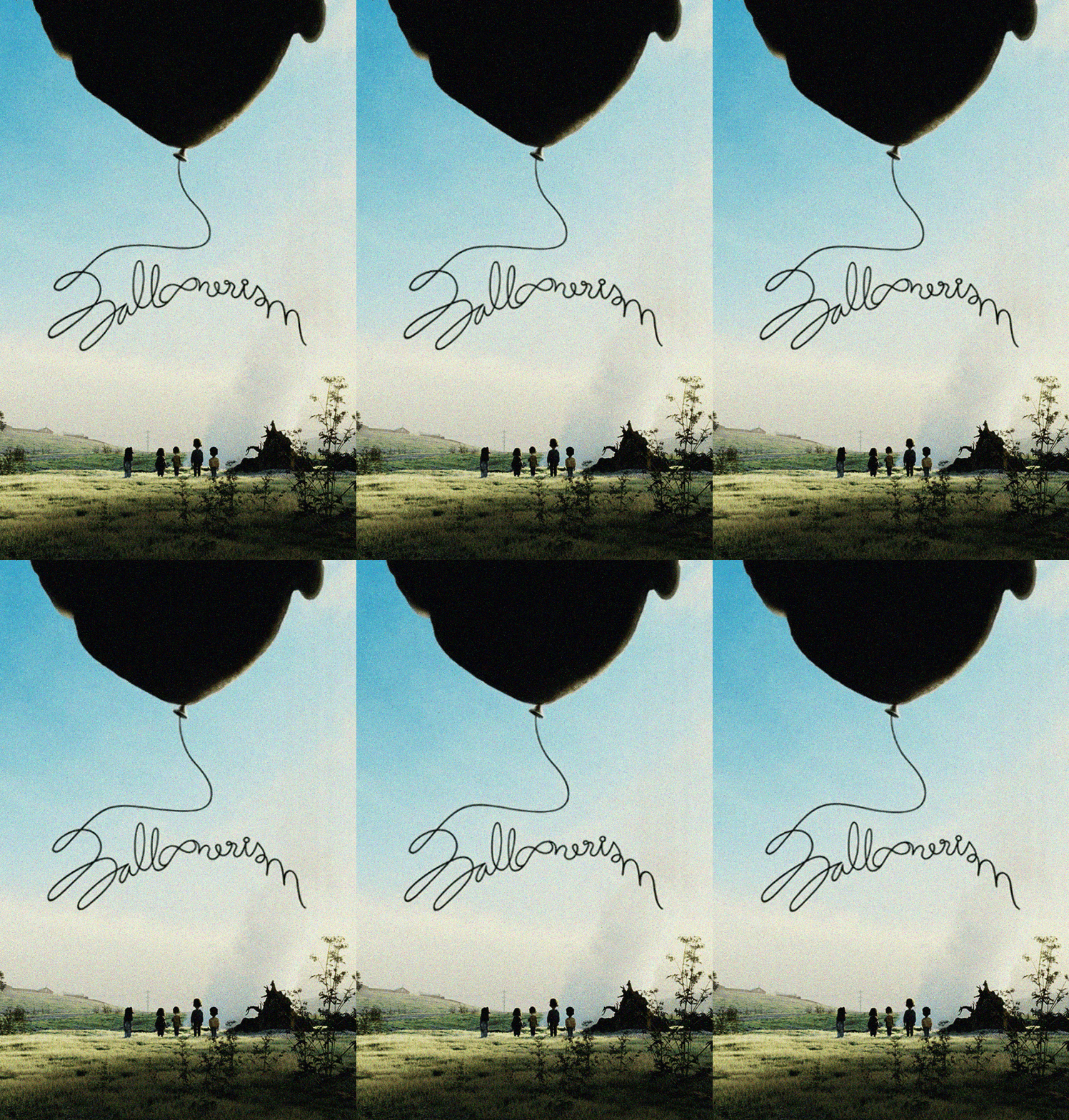
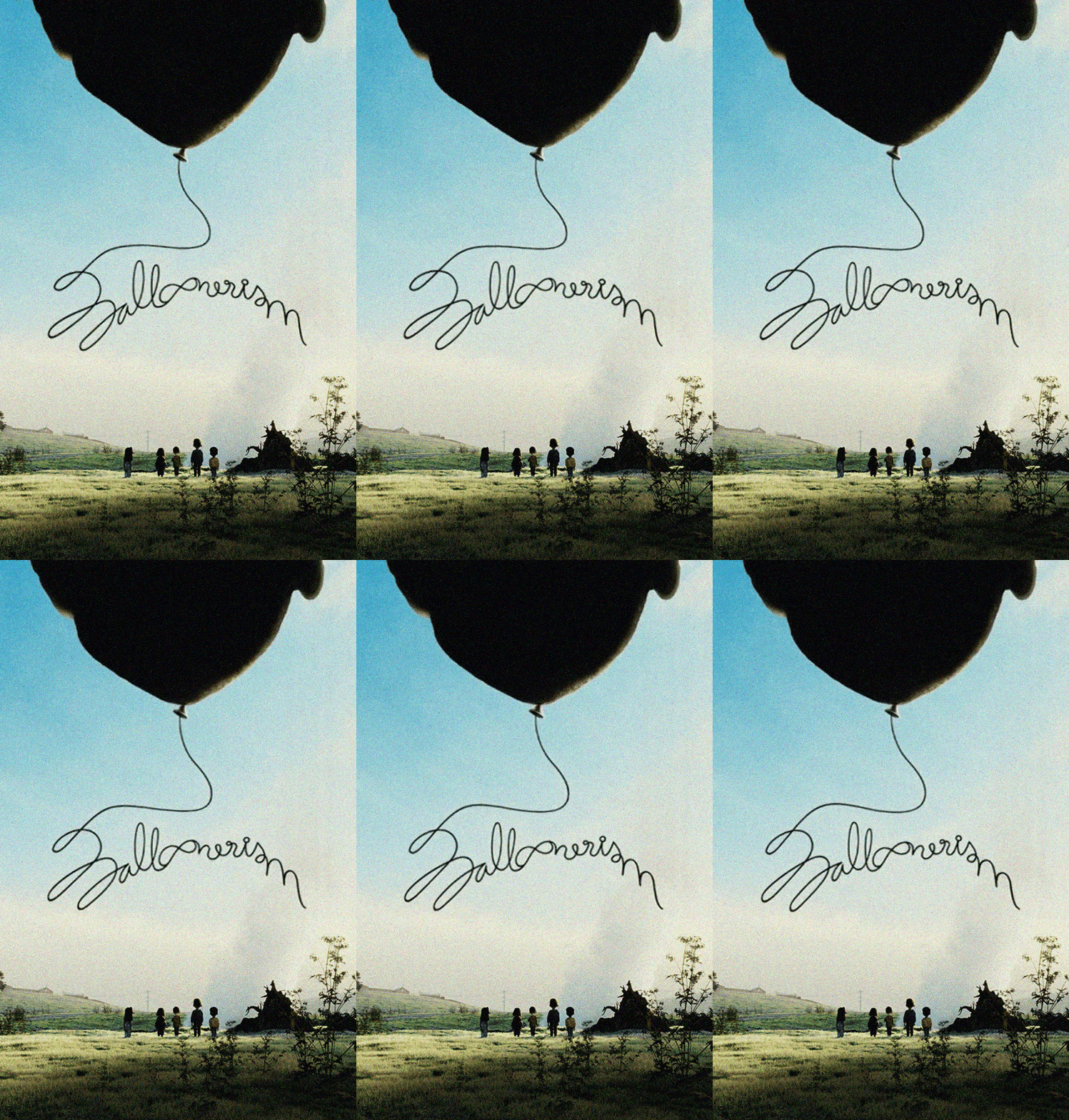
When working on this piece, scheduled to go up January 19th, the day Malcolm would’ve turned 34, I finished reading Islands in the Stream, the first of the posthumously published novels of Ernest Hemingway. In 1950, Hemingway started working on a sea trilogy comprising three sections: The Sea When Young, The Sea When Absent, The Sea in Being, which his wife and editor combined with previous island stories and published as Islands in the Stream in 1970. On the first page of the book, the note said: “Charles Scribner, Jr. and I worked together preparing this book for publication from Ernest’s original manuscript. Beyond the routine chores of correcting spelling and punctuation, we made some cuts that Ernest would surely have made himself. The book is all Ernest. We have added nothing to it.” The amount of care and intent Mary Hemingway put in that note stuck with me for days and deeply resonated with all the love I felt in the work Malcolm’s family has brought to life with the help of Sam Mason, a visual artist and director weaving narratives through tactile dream worlds. After starting his career under Pete Candeland, the visionary director behind the Gorillaz music videos, Mason continued working across animation, live action, and mixed media, while catering his unique vision to music artists, including Future Islands, Bomba Estéreo, Sofi Tukker, The Strokes, YGT, and the late Mac Miller. Colors and Shapes, the music video he directed as a tribute to Mac Miller, commissioned by his family and starring Malcolm’s dog Ralphie traveling through the ethereal world of danger and magic, has received heartfelt feedback from Miller’s fans and collaborators. In 2024, he directed Balloonerism, the short film companion to the eponymous album by Mac Miller, breaking new ground in artistic vision and subsequently winning the UKVMA 2025 Best Animation.
“While beneath the ocean, I met with the captain, who sank to the floor on his ship. All of his passengers escaped to safety, but he was not done with his trip. He looked up and smiled, asked me: How do you do? I told him: I'm losing my grip. He told me: Son, if you want to hold onto yourself, then let yourself slip.” – Colors and Shapes
The last line said by the captain might seem counterintuitive at first, it might not make a lot of sense in the real world, but the beauty of the dream world is that anything you can imagine, is real. This world is operated by a different set of rules where thought is real and physical is the illusion. The lyrics to Colors and Shapes are closing with Malcolm’s gentle ask: If I jump, let me fall. What we call impossible is simply what we haven’t seen yet. We never know what’s gonna happen next in the world of imagination. No need to be afraid to fall – you might fly instead.
KELLY KORZUN: Hey, how are you? Hope you’re feeling better. It’s been a minute.
SAM MASON: I’m doing good, thank you. I’m better from the flu. Slept twelve hours or something, which is good.
KK: Great. First off, congrats again on Balloonerism and everything it has blossomed into. It’s such an amazing body of work, which I’m very excited to talk to you about today, especially considering that I knew about the project since its very early stages. When the film came out, I was very tempted to reach out and offer to chat, but, to be completely honest, I try not to approach the artists when they are in the process of surviving the press vortex because by presenting the project you learn a lot about it in retrospect, so I prefer to wait for the dust to settle a bit. When I first thought about reaching out to you almost a year later, I remember thinking to myself: “I hope Sam won’t think I reached out because of the scarf I left at his place two years ago”.
SM: It’s been two years already? Wow.
KK: I know. The post-pandemic concept of time is wild. It’s ok if you don’t have it. As Joni Mitchell said, “something’s lost and something’s gained in living every day”, and Joni Mitchell never lies.
SM: Oh, I’m sure I still have it. I’m gonna look for it.
KK: But I remember that around the same time you shared some very early concepts of Balloonerism with me when you were looking for the artists to collaborate with on the film. It’s been two years, but it doesn’t feel that long. To me, it feels more like reuniting with an old friend and a fellow dreamer. The creative community in NYC, and in Brooklyn specifically, is pretty tight, so all the artists whose work has a similar quality to mine, this dreamlike surrealist aesthetic, feel like family to me, people like you, Mario Hugo, and Saad Moosajee. This quality might originate from different sources, but there’s a very specific language that we use…the longing for home, the nostalgia.
SM: Yes, definitely. I get what you mean. Certain naiveté.
KK: When I was doing a deep dive into Mac Miller material, I came to realize that I totally missed this entire era. Now, I’m openly a fan, but I didn’t quite realize the scale of Mac Miller when he was in the spotlight or even after he passed away and all fellow artists, fans and collaborators vocalized how much he meant to them. He meant so many things to so many people.
SM: I think it’s a generational thing. When he was making music, I wasn’t keeping up with what was happening in mainstream music at the time, and I think his music belongs to the generation below us. I only found out about him when he passed away, just like you.
KK: Yes, I think you’re right. If I had to think about an example that’s more relevant to our generation, it would be Chester Bennington and Chris Cornell. There’s always an influential figure like that whose legacy penetrates the entire generation.
SM: Yes, but now I see a lot of young kids who are fans of Mac Miller as well. A friend of mine is a painter, who has actually helped with some of the designs for the film, and he told me that his 17/18-year old daughter is a big fan of Malcolm. When working on the film, I was really humbled and touched by learning more and more about how much he meant to other people. When working on a music video for an artist, I don’t think that it’s a pre-requisite to already have a connection to their music. My introduction to him was really through Colors and Shapes, which I only later discovered was not super representative of his catalog. Going in fresh like that allowed me to respond directly to the music in front of me as a filmmaker with the emotion of the particular song. I've never been very good at looking at an artist like a creative director or someone with responsibility toward the brand, and I think that I generally do better with a single piece of music and the idea for a short film scored by that music. The world of Colors and Shapes and subsequently Balloonerism emerged from that slightly unsophisticated place.
KK: There’s a very interesting thing that Malcolm said in the conversation with Rubin during their sessions at Shangri-La. He said that he always writes what feels natural to him, but sometimes he would lay out something dark and start having internal debates on whether or not he would want to release it. Rubin asked him what would be the reason to think it wouldn’t be right to release it, to which Malcolm replied: Cause I don’t think that that’s the only aspect of life. That specific quality that I referred to, there was a lot of it in Malcolm’s work. As I said, the references and the sources it stems from would be different for the artists in that same lane, but mine definitely comes from Chagall, and if you look closely at his work, there’s no sense of gravity. Objects and people are just floating, and that’s what gave all of his paintings this surrealist dreamlike quality because it’s something you’d see in a dream. Dreams oftentimes don’t make any sense, and it’s ok for the things to exist without making any sense – it’s more of a feeling, and a feeling is one of the realest things out there, despite not being tangible. If you listen carefully to Malcolm’s lyrics, there’s a recurring theme of falling, floating, flying, which, as you said, serves as a perfect foundation for the surrealist storytelling style. Do you remember what influences led you to this particular aesthetic?
SM: It’s an interesting question because I learned about my work from the response, not so much from something that I’d set out to do. Speaking that language freely is something I’ve been trained to do through the feedback coming from other people. It’s almost like being constantly told that you’re a redhead and learning to tell people the same thing over time. I think that part of it comes out of limitation because I struggle with attention deficit, and when I’m trying to imagine a story, the storytelling tends to be a bit mechanical, with things happening one after the other, in a Charlie Chaplin comic strip style. When I’m hearing a piece of music, the images come to me in a sequence where a story plays out in big changes in perspective, and it all requires surrealism. It all goes back to the first movie I made in my early 20s about this little robot floating around. Back then, I didn’t know how to use animation, I didn’t plan it much – I just laid out all shots one after the other, without a story board. Stylistically, I don’t think my work evolved very much from there, but it was likely influenced by something that grabbed me as a kid.
KK: Are you referring to Wild Robot?
SM: Yes. I think I was emulating Terry Gilliam’s The Adventures of Baron Munchausen, and as I child I remember thinking that the movie was done by someone a bit irresponsible, you know? It didn’t feel like a grown up movie because there were no defined rules, and I didn’t even think it was that great of a film, yet it was amazing because there was a sense of no grown ups in the room, which is what I think all Terry Gilliam’s movies are about.
KK: Now that you’ve referenced Munchausen, I can see it in some of your characters, for example, in the captain in Colors and Shapes.
SM: I love Terry Gilliam, and I think that making films like that today can be quite challenging. Because of the economical situation back in the day, the audience’s taste, the success of Monty Python, the studios would help him produce all these sprawling epics. His films are very wonderfully haywire, they were unlike anything else made before or since, which is what really excited me – the possibility of manipulation through the private process of drawing, and inventing in a technique that is unique to you, that no one can really help you with. For better or for worse, I had that same approach to filmmaking, which leans a lot on computer animation and the fact that, production-wise, I carry a lot myself, so no one can really get in the way. I’m not always happy with it as it can be quite exhausting, but it is what it is. As I get older, I tend to want to ingest things that are more heavy on the storytelling, but the way I make things still revolves around this pre-adolescent dream sequence, which is my natural instinct.
KK: As creatives, we can be very hard on ourselves and take whatever we have ingrained in us for granted to an extent because our mind is always in the space where we want to expand our creative capacity, and I think that there are ways to elevate storytelling without feeling like we’re not enough or what we’re doing is not enough by finding the right people to collaborate with. Your visual style is built on your unique talent to tell stories in a beautiful non-linear way, which is similar to how our brain naturally operates. We don’t store memories in this perfect chronological order, we don’t organize them, they simply exist. When you’re daydreaming, when you’re not burdened by gravity, you feel truly free because you don’t care if things make sense or not. Kids are the best artists because they go with the feeling unlike grown ups who need to rationalize every little thing. It’s important to recapture that child-like fascination with the world.
SM: Exactly.
KK: Going back to Wild Robot, I know that you co-wrote the music for the film. How did it come about?
SM: At the time, I was doing a foundation year in London, I think I was 21. After finishing high school, I didn’t go to college, and I was mostly working as a landscape gardener and a musician. Back then, I was touring as a drummer and I had a girlfriend who was British, so I decided to to Saint Martins for a year, which was relatively cheap, it was only 5K versus 40K here in the U.S. After getting a loan for 5K and coming to London, I was shocked, and especially because I was a bit older, at how relaxed the program was here, which was a bit disappointing because I was determined to work hard. Even though I was doing an illustrating program and working on the animation for Wild Robot, I was still thinking of myself as a drummer, and since the film needed music, I went back home to Martha’s Vineyard in Massachusetts where I grew up and still had the equipment I could use. I just recorded with my friends, people I’ve been playing with since childhood, particularly this incredible musician Milo Silva who had been obsessed with Tuvan music. I don’t know where he is these days, but he played a traditional Mongolian horsehair string instrument, which is what you hear on that track through a delay pedal. We all just jammed for a few hours, I cut the music up, and that was the soundtrack. People really liked the soundtrack, which is what caught the audience’s attention and kicked off my whole career in a way. It gave me more confidence to move forward and do more things.
KK: Do you happen to have a favorite drummer?
SM: If I had to choose one, I’d probably go with Levon Helm, who is a very soulful drummer, and I got to meet him, but also James Gadson, Jim White , the Dirty Three drummer switching sticks for brushes. Who’s yours?
KK: There’s so many, and I think it would be unfair to choose one, but my love for drums definitely started with Phill Collins. His skill is so effortless, not to mention singing and drumming at the same time while looking like your friendly office tech guy.
SM: I don’t play drums that much anymore, but growing up, I was into non-athletic drummers who were not super fast or technical, that were kind of scrappy. Neil Peart, the drummer of Rush, would be the drummer my friends and I would make fun of because he had too many drums, we saw him as a show-off, but now I appreciate all that stuff, musicians like Phil Collins, especially his songwriting. I’m less judgmental now as I get older.
KK: I’m curious about what informed your music sensibilities. What kind of music did you listen to growing up?
SM: My family are folk musicians. My parents were professional songwriters, as well as my brother, and to rebel against that environment, I listened to a lot of hip-hop when I was young.
KK: What kind?
SM: I liked Philly stuff, OkayPlayer, The Roots. Also, OutKast, Mosdef, Common. Then the hipsters showed up when I was in high school, with all that ironic Vice Media hipster attitude, and I remember feeling sad because all the hip-hop I liked back then wasn’t considered cool anymore. Later, I got into more experimental music, and the psychedelic music of the 70s and 80s, so I missed out on a lot of things happening in the contemporary music during that time.
KK: The universe works in mysterious ways, and it sure found a way for Mac Miller’s music to enter your creative space. There’s a story I wanna share with you about Little Things, a short film you’ve co-directed with our mutual friend Mario Hugo, the work that has deeply resonated with Miller McCormick, Malcolm’s brother, and brought so many things into your life. A few years ago, I created this winter-inspired animated piece that was showcased on all information stands in NYC during the holiday season. It was inspired by the lyrics to The Place Where Lost Things Go written by Marc Shaiman and Scott Wittman for Mary Poppins Returns. The song comes at a particularly poignant moment in the film, as Mary Poppins sings a lullaby to the Banks children, who are grieving their late mother, telling them about the place where lost things go, and that their mother is there watching over them. Not sure if I showed it to you.
SM: Yes, you did. It’s lovely. Really nice.
KK: “Do you ever dream or reminisce, wondering where to find what you truly miss, searching for the things you used to know, looking for the place where the lost things go. Time to close your eyes, so sleep can come around, for when you dream you’ll find: all that’s lost is found. Maybe on the moon or maybe somewhere new, maybe all you’re missing lives inside of you. Spring is like that now, far beneath the snow, hiding in the place where the lost things go.” New York felt very lost and lonely during the pandemic, so I really wanted to create something to cheer people up and give them hope. The piece captures one of my favorite views in the city, over a high line park. On top of that, I wanted to create something that my daughter would like, something that would evoke childhood wonderment and nostalgia. Years later, I showed this piece to Mario, and he mentioned a short film he had made with his friend called Little Things that he dedicated to his daughter August Marie. We talked about the importance of fostering curiosity in our kids, the ability to see beauty in the ordinary, which is what Little Things was all about.
SM: Oh, I didn’t know that. It’s funny. Lost Things, Little Things.
KK: That memory unlocked only when I started doing a deep dive on Colors and Shapes, and then all dots have finally connected. In one of the interviews, Miller said that Little Things made things feel ok at a time when things really didn’t feel ok, and that when he muted the video and played Colors and Shapes over it, it synced together in the most eerie way. It was their mom’s favorite song, right?
SM: Yes, it was Karen’s favorite song from that album. When I heard the track, and because Malcolm sings it, I remember thinking there was a certain sweetness to it and that it would work really well with something similar to Little Things, the universe I knew how to work with. The key components that came to mind right away were a slow-moving drifting camera, night world, oversized disembodied landscapes of objects, Beauty & The Beast type of feeling. Another reference was Little Nemo: Adventures in Slumberland, with the bed flowing in the sky, which fit the music and worked well with the idea of the journey through the imagination of a creative child.
KK: It all worked together so beautifully. When making Balloonerism, did the things align in a similar way?
SM: With Balloonerism, where he was rapping vs singing, and the lyrics were darker, with vice, humor, and some darker strains, the main challenge was balancing the childhood sweetness with a bit of an edge. As a starting point, I turned to things like Fritz the Cat, Cool World, the adult animation, something I’d rent on VHS at a video rental place when I was a kid – the section where you’d find cyberpunk anime like Akira, Ghost in the Shell, and other adult animation made between 60s and 80s, with this pulpy, crude, funny feel to it. Balloonerism didn’t end up being R-rated, it still had this hopeful feeling to it. Looking back, another challenge we were battling was the density and the chaos of lots of things happening with music and all the characters.
KK: Did you feel the need to strip back to give the story more space?
SM: I feel that now. I think I felt it while making it, but I didn’t act on it in the process. Did it feel overwhelming to you?
KK: Maybe if I didn’t know the context, it would feel different, but since I knew what exactly you were making, I understood the challenges of it, that, ultimately, you had to make a long-form music video, while syncing storytelling in all its complexity to a very condensed piece of music. When you work within a single track, the framework is a bit more predictable. Balloonerism is more fast-paced and, as a body of work, it relies on the lyrics a lot. Not to mention that the characters need to interact with each other in the way that makes sense to the audience. There’s a lot to navigate production-wise, and I think you did a spectacular job with it. How did you feel about working with such a big team of visual artists?
SM: I think the main challenge for me was figuring out what I was doing before communicating it to the team – it’s not easy to improvise and pivot with a hundred people. However, that was a big learning experience for me and a big step in learning the process of working with a big team and the importance of getting your ducks in a row before you commit.
KK: What was the most rewarding part?
SM: The most rewarding part was seeing the team coming together like a summer camp and really getting into it, and being devoted to it for a long period of time. With my other projects, with music videos, I’d work with freelancers, and the work would probably mean something for one of two individuals, but, for the most part, I’d create things pretty quietly. Balloonerism, was an ambitious and massive undertaking, we spent months and months working on it, and all of us felt very invested.
KK: I’m sure the reaction from the fans was also one of the rewarding experiences.
SM: For sure. I’m humbled from the response we’ve received so far and how this project has connected me with Malcolm’s fans. Of course, I have a very intimate relationship with his music, I’ve come to love his music, and I have an intimate relationship with his family. The fact that they trusted me with the film is a huge honor.
KK: The way you’ve talked about Malcolm’s work and his family in the press and all the interviews you’ve done while promoting the film speaks volumes of you as a deeply empathetic and caring person. You’ve always handled it with so much care and respect, but I’m sure that carrying that degree of responsibility isn’t easy. There’s a very fine line between honoring a public figure and a speculation, which is something we see a lot in modern pop culture.
SM: That’s one of the reasons I always try to speak about my art and try not to cross other territory. It feels wrong of me to speak on his legacy.
KK: It’s something that I had to navigate when honoring the late Virgil Abloh on stage alongside Joe Perez at OFFF Barcelona this year. Even though I’ve come to built intimate relationships with his close friends and collaborators since he died, and all of them shared many memories of him with me, I wanted to make sure I handle them with respect and care because people’s stories are fragile. All great artists have a certain duality about them, and the complexity of that contrast is what makes them great artists. There would be no light without darkness, no beginning without end, no life without death. We all build a very intimate relationship with the latter, and since death is one of the recurring themes in Malcolm’s poetry, I’m curious about your take on it as a concept. What I’ve always found interesting about it is the idea of renewal, of rebirth, the inevitable change of seasons. Death is an interesting concept because it’s absolute. Anytime you want out, the door is always open.
SM: It’s a lovely question. I don’t find the subject of death particularly interesting for me from the storytelling perspective, but I do think about death and art a lot. One of the benefits about being an artist, and I don’t think it’s only true for artists, is that death is not such a big deal. Most of the things that I love in this world come from dead people. It’s something we can all relate to. I don’t believe in the supernatural, but I do believe that ghosts are real because when you die, you leave a lot behind, and what you leave behind is your ghost, in a way. What it tells me is that death is the end of you in this existence, but you’re not dead to other people, and as long as we exist through other people, we’re still alive. It’s only the conscious part that’s gone, that’s all.
KK: There was this quote by Albert, this mentor from heaven played by Cuba Gooding Jr. in What Dreams May Come: “Do you think your brain that’s all there was to you? Like you’re in the house right now. You’re in your house, that doesn’t mean you are the house. House falls down, you get out and walk away.”
SM: Exactly. What’s important is the effect you had on other people, all the things you’ve left behind, and it doesn’t have to be art or the things you’ve made. It can be things you’ve taught people, your children, the impact you had, all the good you did, hopefully. It’s what we’ve been doing since we crawled out of the trees and began communicating to each other. That’s why this project wasn’t too focused on the topic of death. What moved me was our ability to communicate beyond the physical world. It is one-way, but it’s a two-way communication with the echo of someone, with the work that they left. My dad died just before we started working on the project, and it certainly permeated the project for me, as well as Malcolm's legacy.
KK: Art in itself is always a two-way, energy-to-energy communication, which is why I think the work you did to honor Malcolm’s legacy will have immense longevity. It no longer belongs to you and other people involved in production – it belongs to his fans now, and it’s the most valuable capacity in which we as artists can contribute to this world. Malcolm’s fans will build their own unique relationships with his music through your work, and as long as that relationship stays strong and helps them to navigate the complexity of the journey we call life, his spirit will continue to live.
SM: I hope it will.