Talent Crush: Cyril Paillot
Cyril Paillot is a fashion designer and stylist whose unique vision has been built outside of formal training, through continuous experimentation and intuitive sewing. After exploring cut, volume, and fabric since a very young age and establishing himself as an accomplished fashion stylist by the age of 25, he founded NUE 19.04, an instinctive and sensual brand specializing in leather, silk, and fine materials, playing on the contrast between purity and strength. Being true to yourself and embracing the true colors of one’s authenticity requires immense courage, the word that stems from cor, the Latin for heart. The definition has evolved over time, yet the essence remained. Today, more than ever, it’s only with the heart that we can see rightly.
KELLY KORZUN: I’m excited to chat with you today. It’s been quite a year, but I’m looking forward to coming back to your studio in just a few weeks. Did you grow up in Paris?
CYRIL PAILLOT: I grew up near Paris, in a blended family and with a sense of luminous balance of life that’s already shaken you up a bit. My parents divorced when I was five, and my father disappeared from my life at a very early age. He passed away when I was 14, but I still have some fragmented memories of him left, some lingering yet diffused sensations, like a familiar scent and the power it holds, yet I never lacked love because my mother and stepfather both raised me with a strong, almost militant tenderness – my childhood was truly happy.
KK: Was there a specific book that sparked your imagination in your early years? The dreamlike essence of your work likely arises from the seeds planted in your mind and soul very early on.
CP: My imagination was nurtured by fantastical worlds. Jules Verne, particularly Journey to the Center of the Earth and Twenty Thousand Leagues Under the Sea, left a lasting impression on me. This hunger for exploration of the unseen and inner worlds lives within me to this day. Indeed, I was a very dreamy child, often lost in my own world, quite sensitive and drawn to beautiful things – paintings, textures, clothes. Very early on, I felt the urge to express my individuality through my appearance, I wanted to look different, to create my own style. I always knew that I was different and carried it like a secret. At 15, we left Paris for Cholet, in the Maine-et-Loire region, to be closer to my grandparents. This change was quite significant as it took place at an age when you should be putting down your roots, discovering your sexuality, asserting yourself without hesitation, but, instead, it felt like I had to create a persona to protect my individuality.
KK: Has your family always been supportive of your self-expression?
CP: Always. In the Cholet area, seeing a boy dressed differently wasn’t common, but I embraced that difference. My individuality and all the ways in which it manifested itself has always been supported by my family. At that time, I started sewing without any formal training, instinctively – cutting, assembling, experimenting. Every night in my room, I would craft my outfits as a manifesto – the fabrics became my armor, confessions, flags.
KK: You’re fortunate to have that degree of support because, as you said, it’s a very sensitive age. There used to be a TV show called Âge Sensible that I watched in my late teens via France 2 (FR 2) channel. The story followed a group of university students living in the same dorm, quite melancholic and dark drama series, but it was modern and realistic in comparison to Hélène et les Garçons or Premiers Baisers. Given the scale of Cholet, how did you feel about your school experience there?
CP: At school, eyes would definitely linger on me. People would whisper and stare at me as I walked by – I faced it every day, and it has definitely left me with some wounds and doubts. Some professors would refer to my outfits as provocative, but all I wanted was to be able to express myself and to be myself, no matter the cost. It was my determination that saved me, as well as the support of my family, but I had to build the invisible walls, and these walls hid my vulnerabilities well. For a long time I thought that they were protecting me, but, in reality, they isolated me.
KK: Have you already known that you wanted to become a fashion designer?
CP: Absolutely. I dreamed of Paris, of fashion school, of working for a couture house. My parents’ financial situation made this pursuit uncertain, yet I’m sure they would have sacrificed everything if I had insisted. Around the age of 17, my work got noticed by a kids fashion house, and what started as an internship, turned into an 8-year-long collaboration. This experience was quite intense, but it allowed me to learn my craft, with rigor and high standards. By the age of 19, I was already designing a very successful clothing line, but I wanted to design for women. I’ve always seen clothing as an extension of one’s identity, and very early on I understood that I didn’t want to just dress people – I wanted my garments to convey emotion. With a touch of sadness, I made a decision to leave the company and explore new horizons.
KK: Transitioning from kids fashion to men’s or women’s prêt-à-porter can be challenging because once you make a name for yourself in one lane of work, especially if it’s successful, the industry keeps associating your skillset with a specific area of expertise, and the longer you wait to make a move, the harder it gets to pivot.
CP: That’s why making this decision was extremely hard, but I knew that it was something I absolutely had to do. At the age of 25, I went freelance and immediately got picked up by another kids brand, but they also had a women’s line and were looking for a stylist. At first, they turned me down saying that I had no legitimacy in the adult market, but I persisted and took on a challenge, and my determination turned our collaboration into a lasting success. In 2002, I met someone special, and this encounter became a real turning point, an inevitable pivotal moment. That person shattered the walls I’ve built around me – seemingly protective, yet suffocating. With gentle firmness and unwavering presence, he subtly guided me through all of my projects, our projects. It was a quiet certainty, a profound alliance that reshaped my inner landscape, which continues to ground and uplift me today.
KK: NUE 19.04, the brand you’re referring to, gained international recognition and popularity, including a runway show at the Shenzhen Fashion Week in China and over a hundred points of sale globally, with a flagship store in the South of France. What was the idea behind launching that line?
CP: After all these fruitful and transformative years of designing for women, a part of me still felt like it needed to expand even more. In 2011, along with my partner, we created NUE 19.04 (NUE for its sensual connection to the fabric, with 19.04 being an intimate tie to my birthday), and, for eight years, this brand has been my everything, it brought so many vibrant memories and significant events into my life. Unfortunately, the story came to an end with the arrival of Covid, a period during which the industry suffered a major shock, but I still carried so many stories inside of me that I was yearning to tell, stories of freedom and intimacy, so I turned to sculpture. At first, it was fueled by curiosity, almost like a game, but very quickly the material spoke to me as much as textiles.
KK: Was there any transitional medium before you started working with clay?
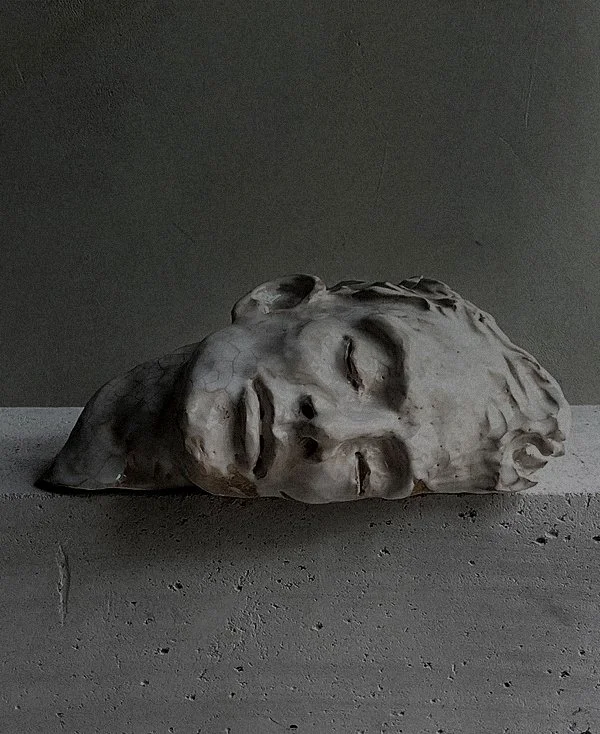
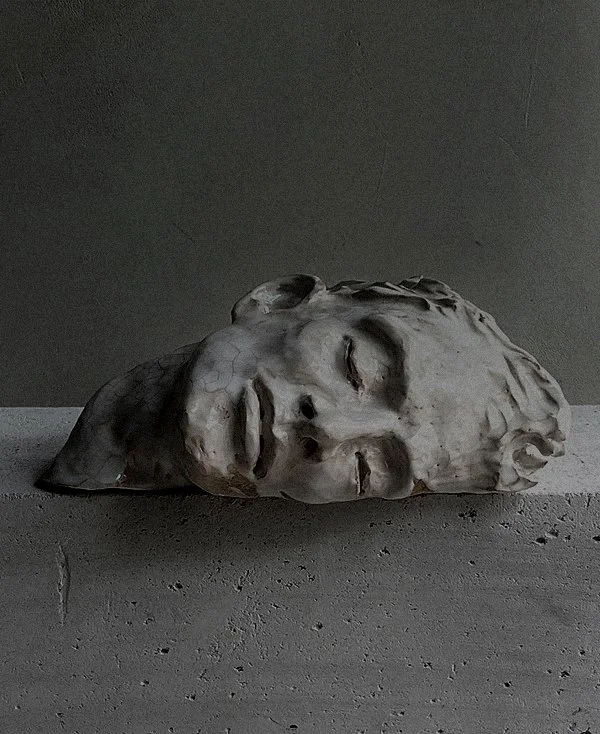
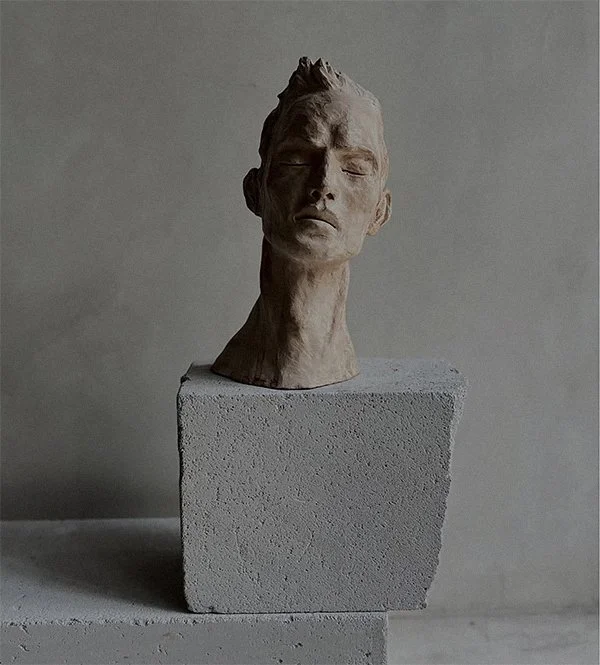
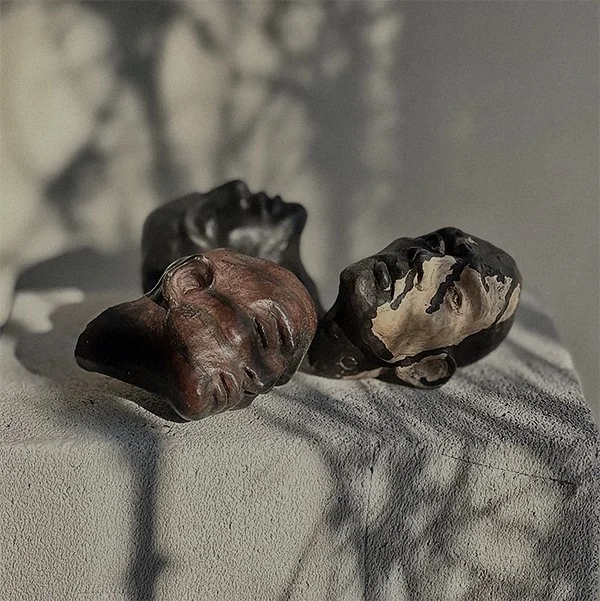
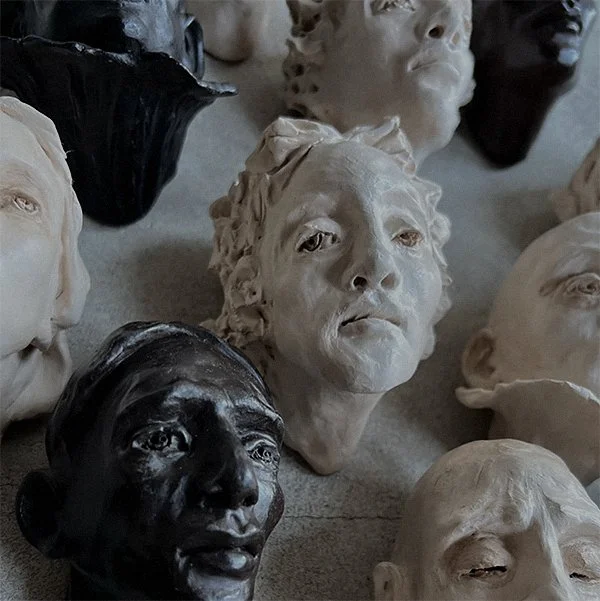
CP: First, I started with plaster, but soon switched to clay. Just as with sewing, I followed my instinct, shaping the material in same way I once shaped fabric, and this is when I felt that I have finally rediscovered that original freedom, the possibility of creating my own language. Today, my work as a sculptor revolves around clay, which I shape to give life to the faces of men and women, whether classic or unconventional, ordinary or unique. The goal is to capture this suspended moment, the emotion that shines through in a gaze or behind closed eyes. My pieces quickly garnered interest of the audience and collectors, allowing me to exhibit in various galleries. In 2023, I opened my own gallery at 69 Rue de Bretagne in Le Marais where you last visited me.
KK: And I remember how excited I was to see your pieces in person. There’s so much emotion coming through the characters, even if you only get to look at them online. Being able to look at your pieces in real life was absolutely beautiful, and I liked the fact that the gallery space operates both as a boutique and a studio, allowing you to create sculptures onsite and present your entire body of work. Apart from clay, are there any other mediums that you find appealing?
CP: Before working with clay, I worked with plaster, plaster bandages, and wire mesh. I like materials that are somewhat raw and ephemeral. Concrete also appeals to me because of its strength and architectural quality. The idea of working with plants and creating installations that combine sculpture and organic elements greatly interests me, regardless of the fragility.
KK: The fragility is what makes it so exciting in the first place, I assume.
CP: Indeed. Clay is still a recent addition to my artistic landscape, and I feel like dedicating many years to it, potentially working towards larger scale, more ambitious pieces, but still centered around the human figure.
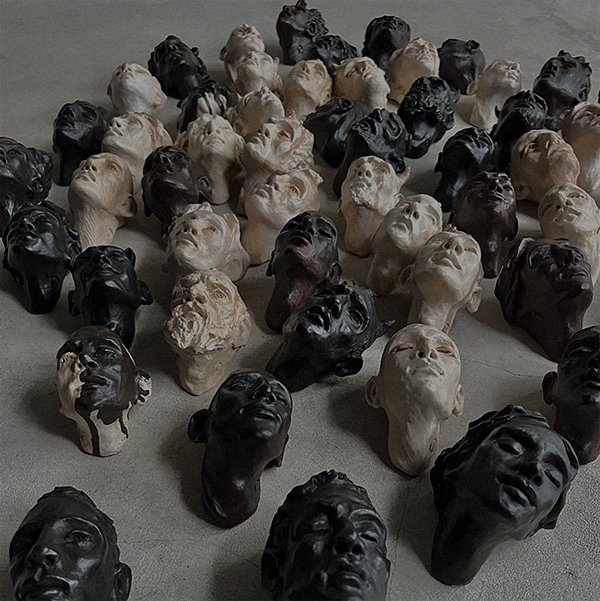
KK: What’s interesting is that even though you’ve transitioned from fashion design to sculpture, your color palette hasn’t changed. Is your choice of a limited color palette intentional, or do you naturally gravitate towards toned down, neutral colors?
CP: When I created NUE 19.04, I built a very sensual, rock-inspired universe, with a deliberately limited palette: deep blacks, asphalt grey, off-whites, neutral tones. I’m not a fan of bright, bold colors. Instead, I prefer half-tones, muted shades, soft harmonies – they allow the eye to focus on attitude, texture, and emotion. Naturally, this color palette manifested itself in sculpture: blacks, sepia, caramel, ochre, ivory, off-white, all the organic, almost mineral colors.
KK: Do you keep an eye to what’s happening in the landscape of fashion these days? If so, do you have favorite designers or houses?
CP: Yes, I still follow what’s happening in fashion. Naturally, my taste has evolved over time, but I still look at Stella McCartney, Saint Laurent, Prada, Loewe, with a particular admiration for Dries van Noten, who is nevertheless very colorful, as well as the worlds I’ve always admired – Margiela, Rick Owens, Ann Demeulemeester.
KK: Just like you, I'm also gravitating towards a muted color palette, but I like how Dries works with color and patterns – it’s always done in a very sophisticated, well-balanced way. Given that NUE 19.04 was inspired by rock music, what role does the music play today in your creative process today?
CP: I’ve always listened to a lot of music, but when I create, I turn to the melancholic or classical music, something that would help me to enter this inner, almost meditative state. Despite the tribulations in my early years, I don't really carry any great tragedy within me, only a gentle melancholy that accompanies me. Atmospheric music allows me to retreat into my own world, it creates a mental space where emotion can emerge. Some music transports me like that.
KK: Some artists prefer to work in silence to go deeply inward, but I agree that music is a great catalyst when it comes to entering a flow state. When I was producing art for my last show, not far away from your studio, I’ve been mostly listening to instrumental and classical music. I remember that we both share love for Craig Armstrong and his record The Space Between Us (1998).
CP: Yes, I love that record. I also love Ryuichi Sakamoto, whom I discovered through the film Merry Christmas, Mr. Lawrence – his compositions have profoundly affected me. The melancholic poetry of Jay-Jay Johanson often accompanies me in the studio, always putting me in an introspective state.
KK: Not sure if there’s any parallel, but just recently I read that many plastic surgeons prefer to listen to classical music for precise, initial incisions. When it comes to the characters you create, do they tend to emerge from imagination or real life?
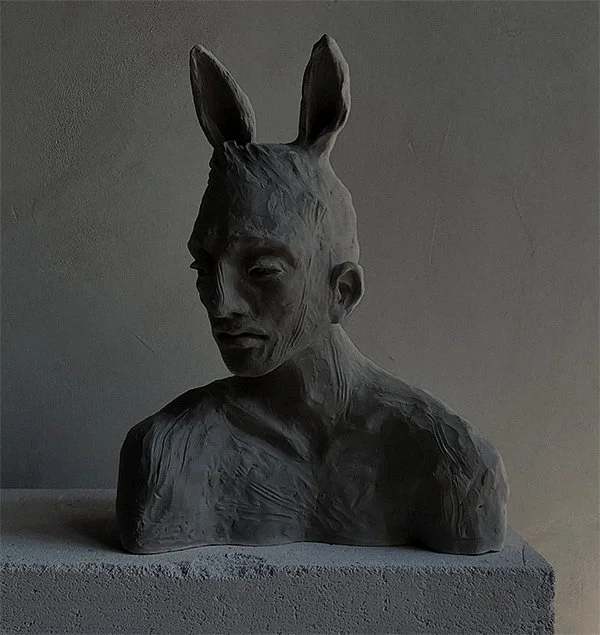
CP: My characters come almost exclusively from my imagination. I rarely work from photographs, and I never know what kind of character is going to emerge, so there’s an element of surprise, which is what makes the play so exciting. For animal figures, I tend to rely on visual references, but when it comes to human figures, everything is filtered through my inner lens, with each character representing a presence rather than a portrait.
KK: Jung once said, “It’s is important to have a secret, a premonition of things unknown. One who has never experienced that has missed something important. We must sense that we live in a world which in some respects is mysterious. The unexpected, the incredible belong in this world. Only then is life whole.” Besides having that playful element of surprise, your body of work is centered around the idea of duality, which Jungian psychology also explored by introducing the concept of the shadow. What drew you to this specific subject matter?
CP: Duality has always been present in my work, and it’s an inevitable part of the human experience. When I worked in fashion, I liked to juxtapose materials: silk, leather, denim…washing them to remove the finish, revealing their true nature, mixing delicacy and rawness. Working with contrast has always interested and excited me. The shadow and the escapism are interconnected, but when I create, I’m not running away. On the contrary, I’m getting closer to myself, to that dreamy, unique child I always was, and, deep down, I still am. I’ve never been consumed by gratuitous darkness. Sure, there’s melancholy and emotional tension, this poetic quality in the characters I create, but never sadness. Some people find them sad. I find them moving. There’s a fragility, but also an immense inner strength – the duality we all can find inside ourselves if only we keep looking.